
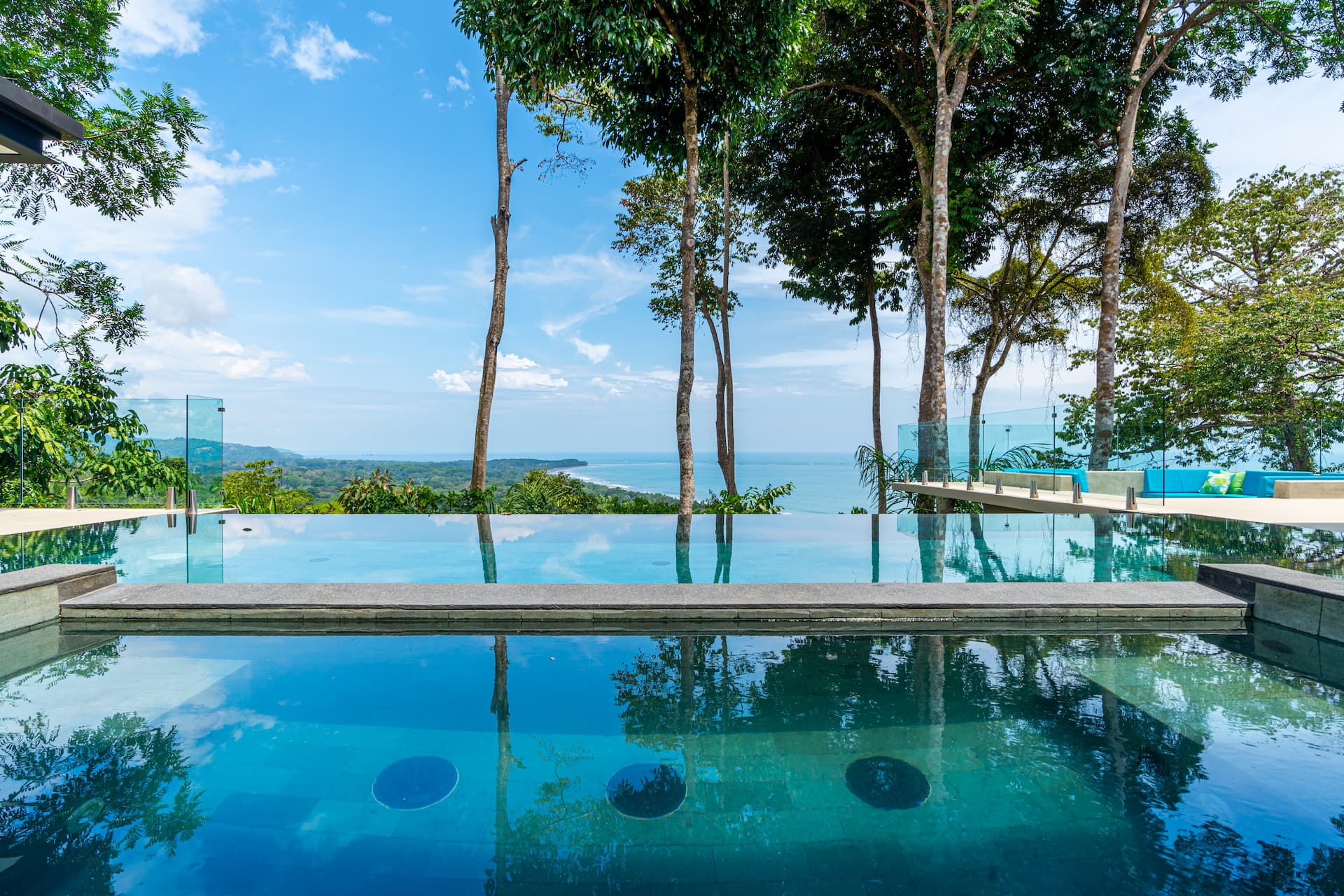
There is a stretch of Costa Rica's Pacific coast that most itineraries skip. The beaches are wilder here, the jungle denser, and the infrastructure less developed than the destinations that dominate travel guides. Dominical and Uvita, separated by a twenty-minute drive along the Costanera Sur highway, occupy this space. For the traveler who finds them, they offer something increasingly rare on the Pacific coast: a landscape that has not yet been managed for tourism.
This is the South Pacific zone, and it operates on its own terms. The pace is slower. The wildlife is closer. The villas perched in the hills above the coast sit within one of the most biodiverse regions on earth, and the mornings here, scarlet macaws crossing the canopy at dawn and the Pacific unfolding below in a light that belongs to no other hour, have a quality that the more developed destinations further north cannot replicate.
Dominical and Uvita are neighboring towns with distinct characters, connected by the Costanera Sur and separated by a landscape of coastal hills, rivers, and protected forest.
Dominical sits at the mouth of the Río Barú, where a beach break of international reputation meets a small, low-key town with a handful of good restaurants and a surf culture that has drawn experienced wave riders for decades. The beach is powerful and not suited to beginners, but the surf here in the green season, particularly from June through October, is among the most consistent on the Pacific coast. The town retains a rawness that more developed destinations have traded away, and that quality is part of the appeal for the guests who choose it.
Uvita, fifteen minutes south, is quieter still. The town center is minimal: a handful of shops, a weekly farmers market that draws the local community, and the entrance to Marino Ballena National Park, which begins at the edge of the village. The famous Whale's Tail sandbar, visible from above and walkable at low tide, extends into the ocean from the park's main beach. It is one of those geographical features that photographs cannot fully prepare you for.
Between and above both towns, in the hills of the Escaleras and the coastal ridges above Costa Ballena, sit the private villas that make this zone one of the most compelling destinations for luxury villa travel in Costa Rica.
The park is the anchor of the Uvita experience, and it deserves more than a footnote.
Marino Ballena protects a marine area of approximately 5,800 hectares, encompassing coral reefs, rocky islands, and the open water that two populations of humpback whales migrate through each year. The southern hemisphere migration, the larger of the two, peaks between August and October. The northern migration follows from December through April. Costa Rica is one of the only places on earth where both populations converge on the same protected marine area, and the sight of a humpback whale breaching within the park's boundaries is one of the defining experiences of the South Pacific coast.
The Whale's Tail itself, a natural sandbar formation that extends into the ocean in the shape of a whale's fluke, is accessible on foot at low tide. The walk across the sand, with ocean on both sides and the jungle-covered hills rising behind, produces a sense of scale and wildness that has become one of the most distinctive visual moments on the entire Costa Rican coast.
Beyond the whales, the park's coral reef system supports sea turtles, rays, dolphins, and a density of marine life that rewards snorkeling directly from the beach. The park is open daily with a small entrance fee, and the experience requires no particular planning.
→ Read our guide to whale watching in Costa Rica
The hills between Dominical and Uvita hold the South Pacific's most dramatically positioned properties, and the landscape that surrounds them explains why.
The Escaleras, a coastal mountain range rising steeply above the Costanera Sur, is covered in primary and secondary forest that has remained largely intact despite the development pressure that has reshaped other parts of the Pacific coast. The road that climbs into the hills passes through a canopy of massive trees, with wildlife visible from the car window on any morning drive. The properties at elevation here have views that extend across the entire arc of the South Pacific coastline, from the Whale's Tail at Uvita to the headlands above Dominical, with the Pacific stretching unbroken to the horizon.
That combination, forest behind and ocean below with the sounds of the jungle constant, produces an atmosphere that is unique to this zone. It is not the beach experience of Santa Teresa or the surf town energy of Tamarindo. It is something slower and more elemental, suited to travelers who come specifically for the landscape rather than the social infrastructure around it.
The South Pacific zone has the densest concentration of private villas in the Maison R&V portfolio, and the range reflects the diversity of the landscape itself.
Casa La Vista sits atop an exclusive hillside enclave near Uvita with five bedrooms and breathtaking panoramic views of the Pacific Ocean and Marino Ballena National Park's Whale's Tail directly below. It is one of the most specifically positioned properties in the zone. Guests can watch the bay from the terrace in the morning before descending for a whale watching tour, the experience already half-complete before the boat leaves the shore.
Villa Bella Vina, in the hills above Dominical, brings five bedrooms, panoramic sunset views, and easy access to both the town and the coast below. It suits a small group or family that wants the South Pacific character without complete remoteness; the restaurants and beach of Dominical are minutes away.
Casa Solaz, near Dominical, offers sweeping jungle and Pacific views from a contemporary four-bedroom property that blends seamless indoor-outdoor living with lush natural surroundings. The setting feels genuinely tucked into the landscape rather than positioned above it.
Villa del Cielo, perched between Uvita and Dominical, is an eco-luxury property designed for families and groups who want modern comfort within a setting that takes the surrounding environment seriously. The infinity pool and jacuzzi face the Pacific. The jungle presses close on every other side.
Casa Grande del Mar above Uvita, Casa Colibri in its gated enclave, Casa ReSol with its Pacific panoramas, Casa Amigos newly constructed in the hills above Dominical, and Villa Birdsong Vista set within seven acres of private jungle. The zone offers options across every group size and travel style, all sharing the same quality of light, the same proximity to the national park, and the same morning soundtrack of birds and ocean that defines the South Pacific experience.
→ Read our guide to private home rentals in Costa Rica
The South Pacific rewards guests who come with some intention around the natural environment. The activities here are not the manufactured experiences of a resort destination; they are encounters with a landscape of genuine ecological significance.
Whale watching from Uvita, particularly between August and October, is the experience most uniquely available to this zone. Operators depart from the small beach at the park entrance and typically combine whale sightings with dolphin encounters, sea turtle observations, and snorkeling on the park's coral reef. A morning on the water here is one of those experiences that functions as a reference point for everything that comes after.
Hiking in the surrounding forests, through the Nauyaca Waterfalls accessible on horseback or by foot from a trailhead near Dominical, or through the private reserves above the Escaleras, reveals the South Pacific's biological diversity in a direct way. The Nauyaca falls, a two-tiered waterfall dropping into a deep pool above the coast, is one of the most rewarding half-day excursions on the Pacific coast and sufficiently off the main tourist circuit that the experience rarely feels crowded.
Surfing at Dominical suits intermediate and experienced surfers, with a beach break that picks up south swells consistently from May through November. The same swells that bring the humpback whales make the surf season here coincide with the most active wildlife period; a convergence that the South Pacific offers and nowhere else on the coast matches.
River kayaking on the Río Barú, stand-up paddleboarding in the calmer waters of the bay near Uvita, and guided birdwatching in the hills above the coast round out a week of activities that can be arranged through Maison R&V's concierge team without the guest needing to coordinate anything independently.
Dominical and Uvita are approximately three hours by road from San José's Juan Santamaría International Airport, along the Costanera Sur, one of the better maintained highways on the Pacific coast. The drive passes through the mountains of the Central Valley before descending to the coast at Quepos, then continuing south through the Central Pacific zone to the South Pacific.
A domestic flight to Quepos, forty minutes from San José, reduces the transfer to a ninety-minute drive along the coast. For larger groups or guests arriving with significant luggage, a private shuttle arranged in advance removes the logistics question and adds a layer of local knowledge to the arrival.
The road from Dominical into the hills above the Escaleras requires a four-wheel-drive vehicle, particularly in green season. Most villa properties in the zone advise on road conditions and vehicle requirements as part of the pre-arrival communication. Maison R&V coordinates this information for every booking.
The South Pacific receives more rainfall than the north, distributed across a longer green season that runs from May through November. That additional moisture is what produces the extraordinary density of vegetation visible from the hillside villas, and it is also what makes the road conditions in this zone more relevant than in drier parts of the coast.
The dry season, December through April, offers the most reliable weather and the easiest access to the more remote properties. Roads are firm, transfers are smooth, and the Pacific visibility for snorkeling and whale watching is at its clearest.
Green season brings the humpback whale migration, the most powerful surf, and a depth of color in the landscape that the dry season cannot replicate. For guests whose priority is wildlife and natural beauty over guaranteed sunshine, the South Pacific in August or September delivers an experience that the dry season simply cannot match.