
Most travelers who come to Costa Rica arrive with the Pacific in mind. The surf towns, the dry season sunsets, the long beaches of the Nicoya Peninsula — these are the images that define the country for much of the world. The Caribbean coast is something else entirely, and that is precisely what makes it worth knowing about.
In 2026, the Caribbean side of Costa Rica has become one of the fastest-growing travel destinations in the world. Flight searches to Limón, the region's main hub, grew by nearly 300 percent compared to the previous year — a number that reflects a broader shift in how discerning travelers are thinking about this country. The Pacific is known. The Caribbean is being discovered.
For guests considering a private villa stay on the Caribbean coast, the experience is genuinely different from anything the Pacific delivers. The landscape, the culture, the rhythm of the days, and the character of the coastline all operate on their own terms. Understanding that difference is the starting point for planning a stay that feels right.
The southern Caribbean coast of Costa Rica — the stretch from Cahuita through Puerto Viejo and down toward the Panamanian border — has a character shaped by centuries of Afro-Caribbean culture, dense rainforest, and a coastline that alternates between calm turquoise coves and wild, exposed beach.
The pace is slower here than on the Pacific. The culture is warmer and more locally rooted. The food is built around coconut milk, plantain, fresh seafood, and the particular flavors of the Caribbean kitchen — rice and beans cooked in coconut water, rondon stew, fresh ceviche, patacones served with everything. A meal here feels genuinely of a place in a way that is increasingly rare in more developed tourist destinations.
The jungle on this coast is denser and wetter than the Pacific side. Sloths are abundant and easy to spot. Toucans, poison dart frogs, and howler monkeys are constant presences. The air is more humid and the vegetation more saturated — deep greens, bright flowers, the particular richness of a rainforest that receives rain year-round.
The beaches range from the coral-fringed calm of Punta Uva to the dramatic exposed stretches near Cahuita and the wild emptiness of Gandoca-Manzanillo further south. Cahuita National Park protects one of the most significant coral reef systems in Central America, accessible by snorkel directly from the beach. The water is warmer and calmer than the Pacific in the dry windows, and the marine life is extraordinary.
Unlike the Pacific, where the dry season runs December through April, the Caribbean coast operates on an almost inverted calendar. The driest and most reliable periods fall in September and October, and again in February through April. These are the windows when the water is clearest, the skies most open, and the beach conditions most consistent.
The rest of the year, the Caribbean receives rain — sometimes significant amounts — but rarely in the sustained, all-day fashion that the phrase "rainy season" implies. Mornings are often clear. Showers arrive and pass. The jungle benefits visibly. And the general humidity, which visitors either love or find challenging, is simply part of the environment rather than an obstacle to it.
For travelers who have planned Pacific trips around the dry season and want to understand a different Costa Rica, the Caribbean windows in September-October and February-April offer an experience that is genuinely unlike anything else the country provides.
The private villa offering on the Caribbean coast remains far more limited than the Pacific, which is itself part of the appeal for guests who value exclusivity. The market has not been developed at the same scale, and the properties that do exist tend to have a character shaped by the environment around them rather than the aesthetics of a typical luxury rental market.
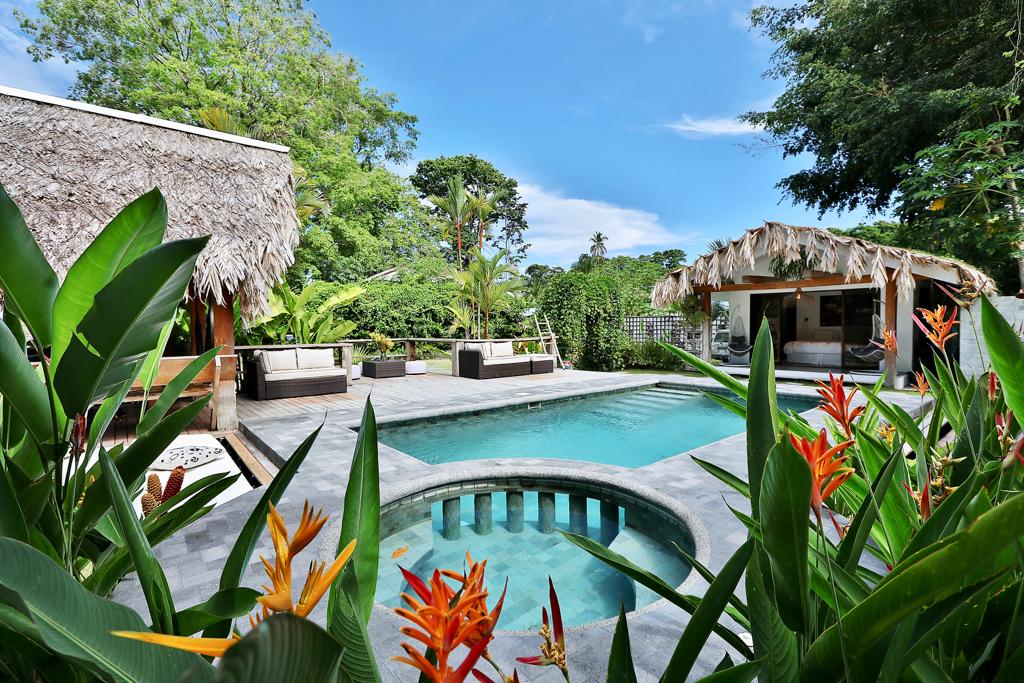
Keep It Green House in Cahuita is Maison R&V's Caribbean offering, and it captures what this coast does well. Set in the lush gardens of Cahuita, within easy reach of both the national park and Punta Uva Beach, the property accommodates up to thirteen guests across three bedrooms and four bathrooms. A private pool, a hot tub, air conditioning throughout, and a kitchen that supports the kind of cooking this coast is built around.
The setting is what defines it. The garden is tropical in the truest sense — dense, alive, and constantly producing the sounds and sights that visitors come to the Caribbean to find. Sloths have been spotted in the trees above the pool. Toucans are regular morning visitors. The coral-rich beach at Cahuita National Park is minutes away on foot or by bicycle, and Punta Uva, one of the most beautiful and least crowded beaches on the entire Caribbean coast, is eight minutes by car.
For families, the combination of pool, garden, and proximity to the national park creates a week that organises itself naturally. For couples or small groups who want a genuinely different version of Costa Rica, the Caribbean atmosphere of Cahuita — its music, its food, its unhurried pace — offers something the Pacific cannot replicate.
The activities available on the Caribbean coast are different in character from the Pacific, and the difference is part of the appeal.
Snorkeling in Cahuita National Park is among the best reef experiences available in Costa Rica without a boat. The park's coral reef, accessible directly from Playa Blanca, hosts sea turtles, parrotfish, rays, and a density of marine life that rewards even casual swimmers. Entry is by donation and the park has a genuine, understated quality that the more developed national parks on the Pacific sometimes lack.
Kayaking through the mangrove lagoons and waterways of the region — particularly around Punta Uva and Gandoca-Manzanillo — reveals a version of the Caribbean jungle that cannot be seen from the road. The water is calm, the wildlife is close, and the experience is as quiet or as active as the group wants it to be.
Sea turtle nesting season runs from March through October, with green turtles and leatherbacks coming ashore at Tortuguero to the north and at the beaches of Gandoca-Manzanillo to the south. Witnessing a nesting or hatching event is one of the more profound natural experiences available anywhere in the country, and the southern Caribbean coast offers it in a context that feels genuinely wild rather than managed for tourism.
The food culture alone is a reason to spend time here. The Caribbean kitchen is distinct from anything on the Pacific coast and from the general Central American canon. Rondón, the slow-cooked seafood and vegetable stew that is the signature dish of the region, is worth seeking out specifically. The restaurants in Puerto Viejo and Cahuita are small, locally run, and produce food that reflects the culture around it.
For guests staying a week or more in Costa Rica, a split itinerary combining the Pacific and Caribbean coasts offers one of the more complete experiences of the country available.
The two coasts are separated by the Central Valley and, on a practical level, by a three to four hour drive or a short domestic flight. The contrast between them — Pacific sunsets and surf culture on one side, Caribbean warmth and rainforest density on the other — captures the genuine breadth of what Costa Rica holds.
Maison R&V can coordinate villa stays across both coasts as part of a single bespoke trip, with the logistics and concierge support managed from arrival to departure. A week divided between a Pacific property and Keep It Green House on the Caribbean delivers two genuinely distinct versions of the country within a single itinerary.
→ Read our guide to the best time to visit Costa Rica
→ Read our guide to luxury concierge service in Costa Rica
The Caribbean side of Costa Rica has something that the Pacific coast, for all its considerable appeal, has largely lost in its most popular zones — the feeling of a destination that has not yet been fully discovered.
The roads are quieter. The beaches are emptier. The culture is more locally rooted. The wildlife is closer. And the particular combination of Afro-Caribbean warmth, jungle density, and coastline beauty produces an atmosphere that is, for the traveler who finds it, genuinely difficult to find elsewhere.
That is changing. The numbers confirm it. But for now, the Caribbean coast of Costa Rica remains a place where the best travel experiences feel like something you found rather than something you were sent to.