
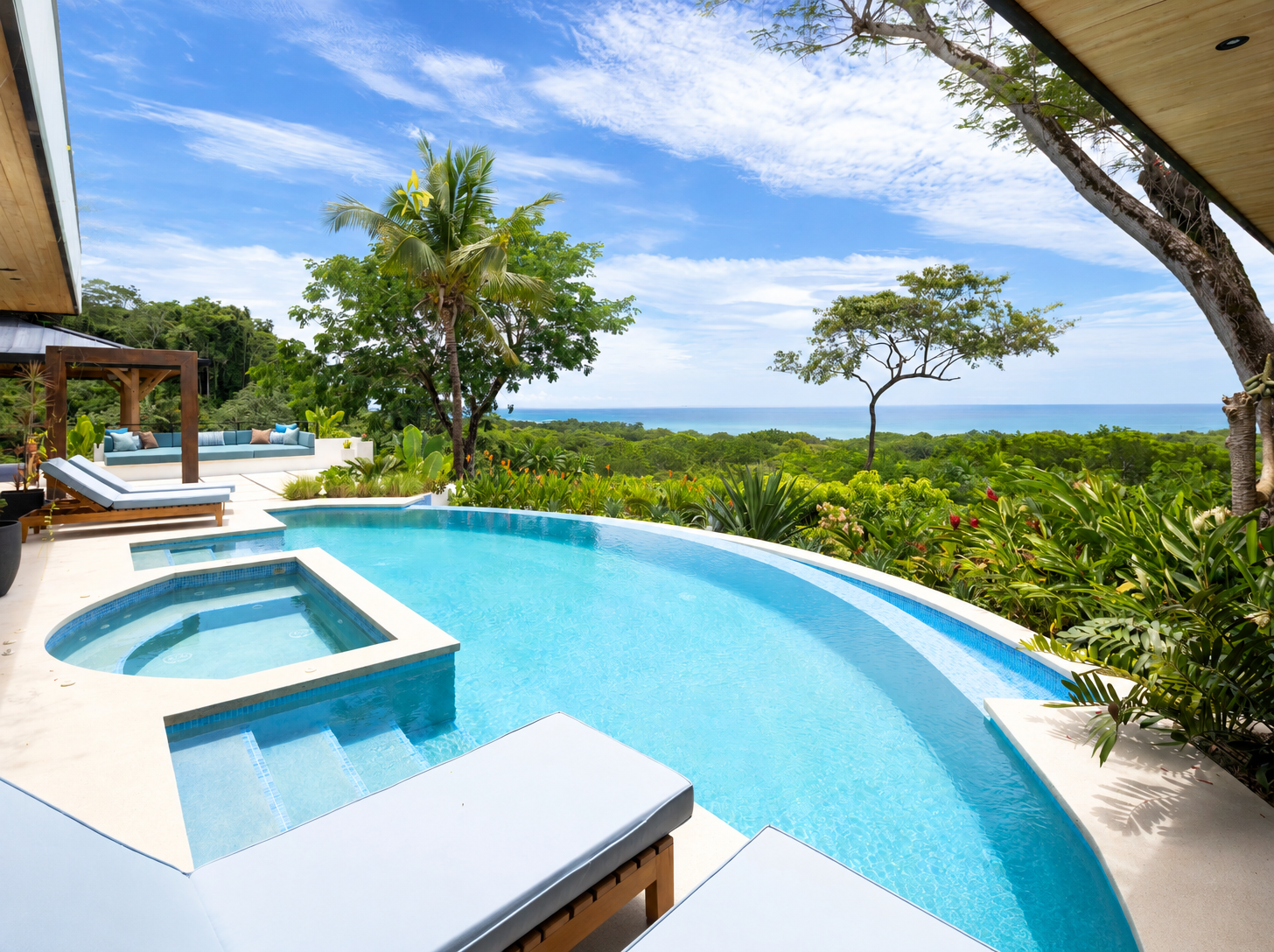
Both destinations appear on the same shortlists. Both attract travelers who want privacy, natural beauty, and a level of service that removes logistics from the equation. Both have built reputations for private villa stays that justify the journey.
Beyond those surface similarities, Costa Rica and the Maldives are genuinely different propositions. Choosing between them well requires understanding what each actually delivers, where each falls short, and which version of a holiday you are actually planning.
The Maldives offers something specific and difficult to replicate: overwater living above a shallow, luminous lagoon. The water color is extraordinary, the snorkeling is immediately accessible from the villa deck, and the architecture of the best properties, suspended above calm turquoise water, is genuinely unlike anything else in the world.
The experience is contained and highly managed. You are on a small island, typically with no connection to the outside world except by boat or seaplane. The resort provides everything, and the best resorts do this with a level of precision and hospitality that is among the finest in the world.
The trade-off is equally specific. The Maldives is one environment. The water, the beach, the overwater villa, the reef below. It is extraordinarily beautiful and, for some guests after a few days, it is also complete. There is nowhere to drive, no town to explore, no landscape that changes as you move through it. The destination rewards guests who want total retreat and asks for patience from those who want variety.
Costa Rica offers the opposite of containment. The country is small but holds more distinct environments per kilometer than almost anywhere on earth: Pacific coast, cloud forest, volcanic highlands, Caribbean coast, dry forest, and the extraordinary biodiversity that results from a biological corridor between two continents.
A week in Costa Rica can move between a Pacific beach villa, a highland nature retreat, and a Caribbean coast property without any of the transitions feeling forced. Or it can stay entirely in one zone and explore it in depth. The destination accommodates both approaches because the landscape itself offers that variety.
The Pacific coast specifically provides a version of the Maldives’ core appeal, warm water, beautiful beaches, excellent snorkeling in the right zones, without the island containment that defines the Maldives experience. The difference is that after the morning swim, there is a jungle behind the beach. Scarlet macaws cross the canopy. A surf break runs along the point. A town with good restaurants is ten minutes away. The day has options.
Water and beach
The Maldives wins on water color and immediate marine accessibility. The lagoon water is calmer, clearer in the shallower zones, and the coral reef is accessible directly from many properties without a boat.
Costa Rica’s Pacific coast has more varied conditions. The surf is real, which means the water moves and is not always suited to casual swimming on every beach. The marine life in protected areas, particularly around Marino Ballena National Park and the Osa Peninsula, is extraordinary, but it typically requires a boat to reach it in its best form. Peninsula Papagayo and its calm protected bay comes closest to the Maldives’ signature water experience on the Costa Rican Pacific.
Wildlife
Costa Rica is not comparable. The country holds approximately five percent of the world’s biodiversity. Scarlet macaws, howler monkeys, sea turtles, humpback whales, sloths, poison dart frogs, and over 900 bird species are present across the landscape. Wildlife encounters happen from the villa terrace without arrangement.
The Maldives offers excellent marine life underwater and very little above the waterline. The comparison is not close.
The villa experience
The Maldives overwater villa is an iconic format that Costa Rica does not replicate. If that specific experience, waking above water, stepping directly into the lagoon from a private deck, is the primary goal, the Maldives is the answer.
Costa Rica’s private villas offer a different kind of distinction. A hillside property above the Pacific with a jungle behind it, an infinity pool that frames the sunset, a private chef preparing dinner on a terrace as the howler monkeys settle in the trees — this is a different register of the villa experience, less iconic in format and more rooted in a specific landscape. The Bahías collection on Peninsula Papagayo, designed by Pritzker Prize-nominated architect Antoine Predock, offers a level of architectural distinction that the best Maldives properties can match but not exceed.
Surf and activity
Costa Rica offers surf, hiking, wildlife excursions, zip-lining, white water rafting, yoga, wellness culture, and a restaurant scene that has matured considerably. The Nicoya Peninsula’s Blue Zone context, Nosara’s wellness community, and Santa Teresa’s surf culture add layers to the stay that the Maldives, by its nature, cannot provide.
The Maldives offers water sports, diving, and the activities of a well-managed resort island. They are excellent. They are also finite.
Accessibility and travel time
For travelers from North America, Costa Rica is significantly more accessible. Direct flights from major US and Canadian hubs reach Liberia or San José in three to six hours depending on origin. The Maldives requires a connection through a hub city, typically Dubai, Doha, London, or Singapore, adding eight to fourteen hours to most North American journeys.
For travelers from Europe, the gap narrows but remains meaningful. The Maldives is an eleven to fourteen hour journey from most European capitals. Costa Rica is nine to eleven hours with a connection or eight hours direct from major European hubs.
The accessibility difference is not trivial. A week-long trip to the Maldives from New York involves roughly thirty hours of total travel. The same week in Costa Rica involves roughly ten. That difference affects how much of the trip is spent recovering from the journey versus actually being there.
Value
The Maldives operates at a premium that reflects its remoteness, the logistics of supplying a small island, and the captive nature of the resort model. Everything is priced accordingly: food, beverages, activities, excursions, and transfers between islands.
Costa Rica at the villa level offers comparable or superior private villa experiences at a cost structure that reflects a functioning country with local supply chains, staff costs denominated in a different economy, and the option to leave the property and use local restaurants and services. The private villa stays managed by Maison R&V on the Pacific coast deliver a level of personalized service and setting quality that is directly competitive with the best Maldives properties at a price point that reflects the difference in operational context.
The honest verdict
Choose the Maldives if the overwater villa is the experience you specifically want, if total disconnection from the outside world is the goal, if you are traveling from Europe or Asia where the journey time difference is less significant, or if the primary activity is diving in the Maldives’ specific marine environment.
Choose Costa Rica if you want variety within a single trip, if wildlife matters, if surf or active travel is part of the plan, if you are traveling from North America and want to minimize transit time, if the villa stay benefits from having a real destination around it, or if the budget needs to work harder without compromising the quality of the experience.
Both are worth the journey. They are not interchangeable.
→ Read our guide to private home rentals in Costa Rica
→ Read our guide to the best time to visit Costa Rica