
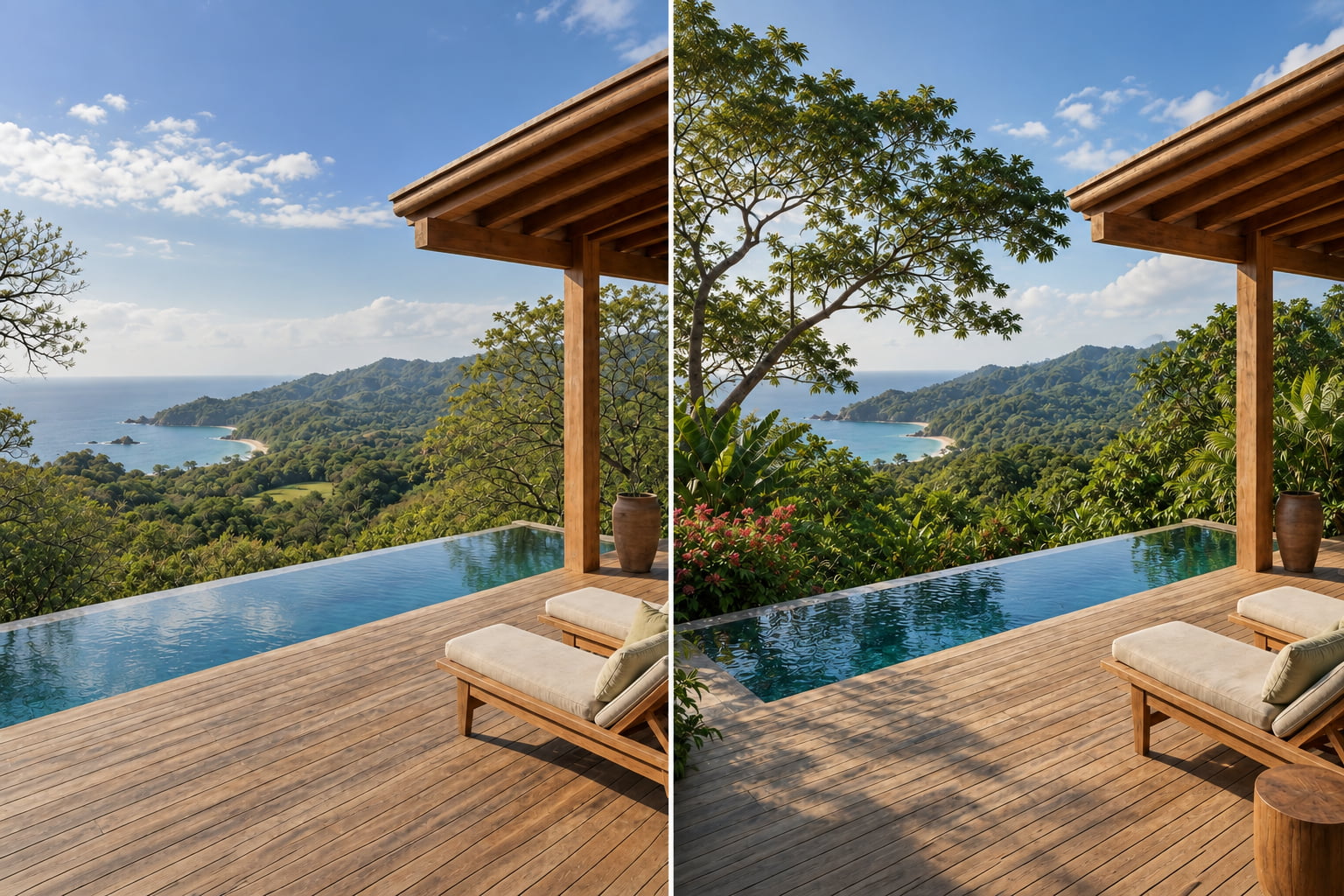
The question comes up in almost every Costa Rica trip conversation, and the answer is rarely as simple as it sounds. Which season is better? The honest response is that it depends on what you are actually looking for, because the dry season and the green season in Costa Rica are not simply good weather and bad weather. They are two genuinely different versions of the same country.
Understanding that distinction is what turns a decent trip into a well-chosen one.
Costa Rica's seasons are determined by rainfall rather than temperature. The country sits close to the equator, which means temperatures remain relatively consistent year-round, particularly on the coasts. What changes dramatically between seasons is the amount and timing of rain, and everything that follows from it.
The dry season runs roughly from December through April. The trade winds blow in from the northeast, keeping clouds away from the Pacific coast for extended periods. Days are long, clear, and reliably sunny, particularly in Guanacaste and on the Nicoya Peninsula, where the dry season can feel almost desert-like by March and April. The Central Pacific and South Pacific zones are drier than usual but retain more vegetation than the north.
The green season runs from May through November, with the heaviest rainfall typically arriving in September and October. Rain does not usually fall all day. The pattern across most of the Pacific coast is clear mornings, building clouds through the afternoon, and rain arriving in the late afternoon or evening. Mornings are often as clear and beautiful as any day in the dry season. The difference is in the afternoon and the cumulative effect of that moisture on the landscape.
A third window worth naming: late November and early December, when the rains ease and the crowds have not yet arrived. Many experienced travelers who know Costa Rica well plan around these weeks specifically.
This is Costa Rica's peak season, and the reasons are straightforward. The weather is reliable, the roads are easy, and the Pacific coast delivers the kind of consistent blue-sky days that most travelers picture when they imagine the country.
The Nicoya Peninsula, Guanacaste, and Tamarindo are at their most accessible and most social during these months. Playa Guiones in Nosara, the beaches of Santa Teresa and Mal País, and the long stretches of coast around Tamarindo all receive consistent surf with good shape and offshore winds that produce clean conditions. The dry forest of Guanacaste turns golden and dramatic, the light taking on a cinematic quality that photographers return for specifically.
The trade-off is predictable. Peak season means peak demand. The most desirable private villas book months in advance, particularly for the holiday weeks of December and January and the school holiday windows of February and March. Restaurants fill up. The more popular destinations see considerably more visitors than at any other time of year.
For families with school-age children, the dry season is often the only practical window. For couples or groups with flexibility, it is worth asking whether the peak season context is part of what they want or simply the default they are accepting.
The best months within the dry season for the combination of reliable weather and manageable crowds are February and March. The holiday visitors have returned home, the surf is still good, and the general ease of travel remains high.
The green season transformation is one of the more remarkable things Costa Rica does. Within weeks of the first substantial rains in May, the dry golden landscape of the Nicoya Peninsula becomes saturated green. Rivers fill. Waterfalls that were dry in April run full in June. The jungle behind Esterillos and the hills above Dominical turn a shade of vegetation that photographers struggle to capture accurately.
The country becomes more itself in the green season. More alive, more loud, more present. Howler monkeys are louder. Birds are more visible. The air carries the particular quality of humidity and growth that is the real atmosphere of a tropical country, not the air-conditioned approximation of it.
Surf improves in the green season across most of the Pacific coast. South swells arrive more consistently and with more power, particularly at exposed breaks like Dominical and the outer reefs of the Nicoya Peninsula. The surf season in Nosara, often considered the best window for more experienced riders, peaks between July and October.
Wildlife activity increases considerably. Humpback whales arrive on the South Pacific coast from July, with peak sightings in August and September. Sea turtles nest on Pacific beaches from July through November. The birdlife across the country is at its most active and most visible during the wetter months.
Rates soften in the green season, sometimes significantly. The most sought-after villas that book six months ahead for December are often available with shorter notice in September. The destination feels more private. The restaurants are quieter. The beaches, particularly on less-developed stretches of coast like Esterillos and the South Pacific, can feel genuinely empty.
→ Read our guide to whale watching in Costa Rica
The seasons do not apply uniformly across Costa Rica. The country's varied topography creates significant differences between zones, and understanding these changes the calculus considerably.
Guanacaste and Peninsula Papagayo have the most pronounced dry season in the country and the most significant contrast with the green season. The landscape here goes from ochre and arid in March and April to dramatically green by June. The green season in this zone brings afternoon rains but mornings that can be as clear as any dry season day. Peninsula Papagayo's protected bay retains good water conditions across both seasons.
The Nicoya Peninsula, including Nosara, Santa Teresa, and Mal País, follows a similar pattern to Guanacaste but with slightly more rainfall. The green season here is when the destination is at its most lush and most surf-productive. Road conditions on the peninsula require attention in the wetter months, particularly on the unpaved roads leading to hillside properties.
The Central Pacific, including Esterillos, Jacó, and the areas around Manuel Antonio, receives more rainfall year-round than the north and has a less dramatic seasonal contrast. Manuel Antonio remains accessible and beautiful in the green season, though the heavier rainfall months of September and October can bring sustained periods of rain rather than afternoon showers.
The South Pacific, from Dominical and Uvita down toward the Osa Peninsula, receives the most rainfall of any zone on the Pacific coast and has the longest green season. The rewards are corresponding: the jungle here is extraordinary in its density and biodiversity, and the wildlife activity during the green season, including the humpback whale migration and turtle nesting season, is unmatched anywhere else in the country. Roads in the Escaleras above Dominical require four-wheel drive in the wetter months.
The Caribbean coast operates on an almost inverted pattern. While the Pacific is driest from December through April, the Caribbean is often wettest during those months. The Caribbean's own dry windows, September and October and again in February through April, are the times when the reef is clearest, the water most swimmable, and the overall conditions most reliable.
→ Read our guide to Caribbean Costa Rica
Rather than a definitive verdict, it is more useful to match each season to the specific kind of trip it suits best.
The dry season suits families with fixed school holidays, first-time visitors who want the most reliable version of the country, guests planning celebration travel or honeymoons where guaranteed weather matters, and anyone whose trip is centered on beach time, snorkeling, or outdoor dining in the evenings.
The green season suits experienced travelers who know what they are choosing, surfers seeking the season's best conditions, guests whose primary interest is wildlife, nature, and the landscape at its most alive, couples and small groups who want more privacy and a less social version of the destination, and anyone with enough flexibility to appreciate what the wetter months actually offer rather than simply tolerating them.
The shoulder weeks of late November and late April sit at the intersection of both: the rains easing or not yet arrived, the crowds thin, the prices moderate. These are often the weeks that guests who know Costa Rica well cite as their preference.
The season shapes the trip in ways that extend beyond weather. It affects which villas are available and at what notice, how roads feel between destinations, which activities are at their best, and what the destination's social energy is like during the stay.
Maison R&V plans itineraries and villa recommendations around the specific season of each booking, with current road conditions, villa availability, and activity options factored into every recommendation. A stay that works well in February requires different logistics and different expectations than the same stay in September, and understanding that distinction before arriving is what turns a season from a variable into an asset.