Costa Rica did not adopt sustainability as a marketing position. It built an entire economy around it before the rest of the world had a name for the concept.
The country protects more than 25 percent of its territory in national parks and reserves. It generates over 99 percent of its electricity from renewable sources in most years. It was one of the first nations to reverse deforestation at scale, watching its forest cover grow from 21 percent in 1987 to over 50 percent today. These are not headline statistics. They are the backdrop to every morning you spend here, every jungle you drive through, every coast you reach after a road lined with protected forest.
For travelers who care about where their money goes and what their presence costs the places they visit, Costa Rica is a rare destination. And within it, a growing number of private villas take the country's environmental commitments seriously at the property level, offering stays where luxury and ecological awareness are not in tension.
Greenwashing exists in travel as readily as anywhere else. A pool surrounded by tropical plants and a recycling bin in the kitchen does not constitute an eco-luxury experience.
The properties worth knowing about share a few genuine qualities. They work with the landscape rather than imposing on it, using natural ventilation, local materials, and design that reduces the energy demand of the building rather than offsetting it. They manage water carefully, a significant consideration in a country where rainfall distribution is uneven and aquifer pressure is a real concern in some zones. They support local food systems, sourcing from nearby farms and producers rather than importing everything a villa kitchen uses. And they employ locally, training and paying staff at a level that reflects the premium the guest is paying.
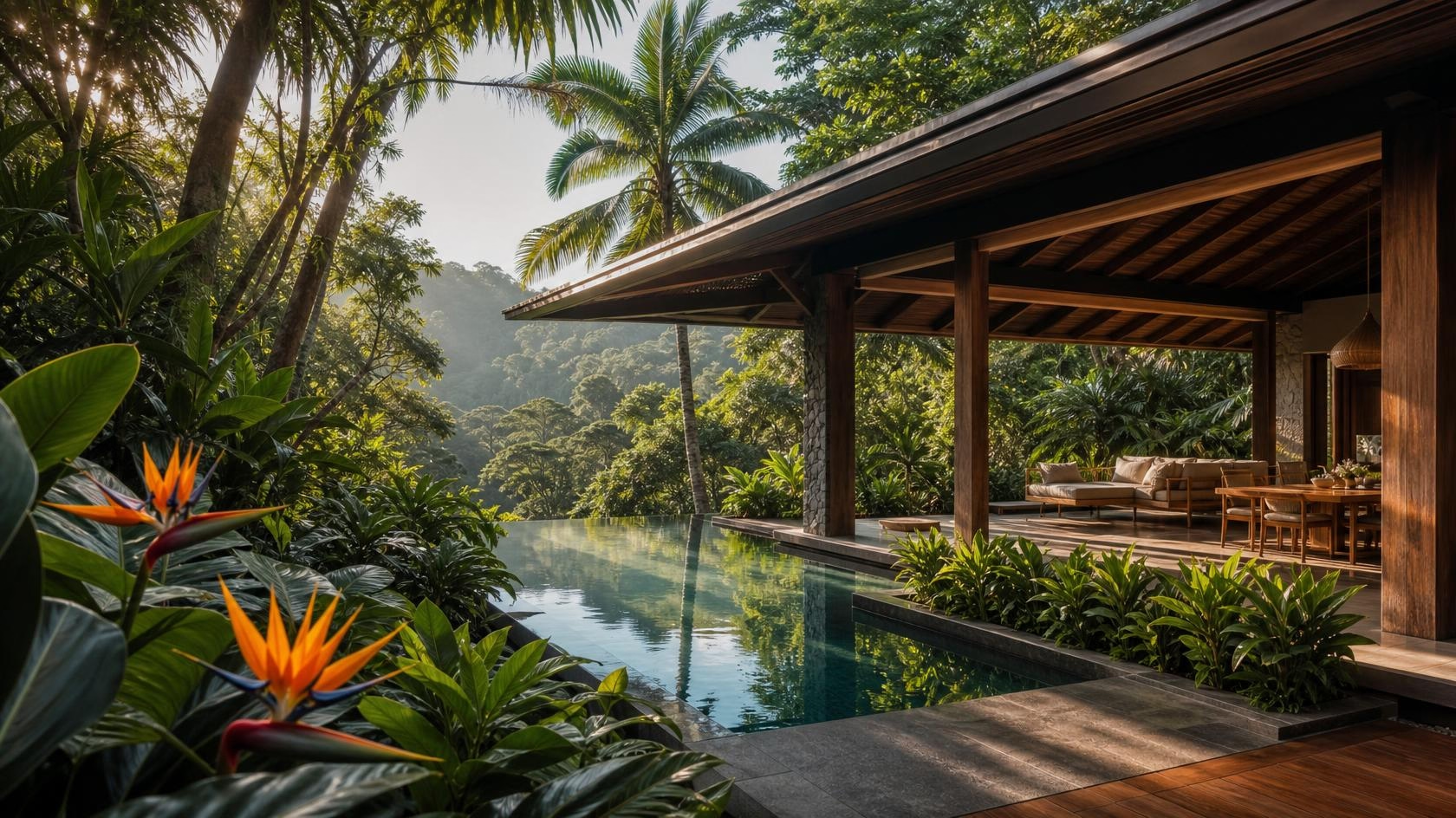
Beyond the operational details, the strongest eco-luxury villas in Costa Rica offer something more subjective: the feeling of being genuinely inside the environment rather than insulated from it. The design invites the jungle in. The sounds are real. The wildlife is close. Luxury here is not separation from nature but immersion in it.
Villa del Cielo, Uvita
Perched between Uvita and Dominical, Villa del Cielo was designed with eco-luxury principles at the core rather than bolted on as an afterthought. The property blends contemporary architecture with natural materials, an infinity pool positioned to minimize visual impact on the surrounding landscape, and a setting above the South Pacific coast that places guests within sight of Marino Ballena National Park.
Four bedrooms, up to nine guests, with indoor-outdoor flow that makes the boundary between the villa and its environment genuinely porous. The surrounding jungle is dense and active. Toucans and howler monkeys are regular presences. The design earns its eco credentials through restraint as much as specification.
Keep It Green House, Cahuita
The name is not decorative. Keep It Green House on the Caribbean coast was built around a commitment to the landscape it inhabits, with lush tropical gardens, solar energy systems, and a design philosophy that prioritizes the health of the surrounding ecosystem. The Caribbean coast of Costa Rica has a different ecological character from the Pacific, and this property reflects it.
Three bedrooms, up to thirteen guests, surrounded by tropical gardens where sloths, toucans, and dozens of bird species are regular visitors. The beach at Cahuita National Park, one of the most significant coral reef systems in Central America, is minutes away. For travelers who want an eco-luxury stay that genuinely demonstrates what the concept can mean at its best, Keep It Green House is one of the most coherent answers in the portfolio.
Calla Lily, Nosara
Calla Lily is described as minimalist eco-chic for good reason. Set on the tranquil hills of Las Huacas, just above Playa Guiones in Nosara, the property was designed with a lightness of touch that the more architecturally ambitious villas in the zone cannot replicate. Four bedrooms, natural light throughout, and an orientation toward the surrounding landscape that feels deliberate at every turn.
Nosara itself sits within the Nicoya Blue Zone and has a community culture that takes environmental stewardship seriously. The restaurants source locally. The surf schools and wellness practitioners have a relationship with the natural environment that shapes how the town operates. Staying in a property like Calla Lily, designed with the same values, produces a coherent experience rather than a contradiction between the villa and its surroundings.
→ Read our guide to wellness retreats in Costa Rica
Villa Kuji Biri, Mal País
Sustainability is woven into the foundation of Villa Kuji Biri, not presented as a feature. The property, perched where jungle meets the Pacific just outside Santa Teresa, was built with local materials, natural cross-ventilation, and a commitment to minimizing its footprint on the Nicoya Peninsula's fragile coastal ecosystem.
Four bedrooms, modern architecture that opens fully to the landscape, and a position that makes the surrounding nature a constant presence rather than a backdrop. The name, meaning Beautiful Ocean in the ancient Maleku language, reflects a connection to indigenous Costa Rican culture that adds a layer of meaning to the stay. For guests who want eco-luxury alongside the energy of Santa Teresa, Villa Kuji Biri holds both without compromising either.
Villa Birdsong Vista, Dominical
Set within seven acres of private jungle above Dominical, Villa Birdsong Vista takes the concept of nature immersion as far as a private villa can take it while remaining genuinely comfortable. The property is surrounded by old-growth forest, which means the wildlife is not supplementary but central. Scarlet macaws, toucans, howler monkeys, sloths, and dozens of species of birds share the grounds with guests in a way that feels neither managed nor performed.
Three bedrooms, up to eight guests, with modern design that keeps a light touch on the land. The seven acres of jungle represent a genuine private reserve, buffering the property from surrounding development and maintaining the ecosystem conditions that make the wildlife presence consistent. For travelers whose primary reason for choosing Costa Rica is the country's extraordinary biodiversity, this property is one of the most honest expressions of what that means at the villa level.
Arenal Springs, Northern Highlands
Set near Arenal Lake in Costa Rica's northern highlands, Arenal Springs operates in a landscape defined by volcanic energy, cloud forest, and freshwater ecosystems that are entirely different from the Pacific coast. Ten bedrooms, up to twenty-five guests, with a yoga deck and grounds designed for deep nature immersion.
The highland setting means cooler temperatures, different wildlife, and a relationship with the landscape that feels more ancient and more elemental than the coast. The lake, the surrounding forests, and the distant volcano create a context in which sustainability is not a marketing choice but a geographical necessity. Properties here exist within a landscape that demands a certain kind of respect. Arenal Springs earns it.
Eco luxury travel is a global trend. Costa Rica is one of the few destinations where the destination itself validates the concept.
The country's conservation infrastructure, its renewable energy achievement, its biodiversity statistics, and the genuine local culture of environmental stewardship create a context in which an eco-conscious villa stay is not a niche preference but a natural expression of being here. The landscape you move through on the way to the property is protected. The food available locally is grown within an agricultural tradition that works with the soil rather than depleting it. The community around the property often reflects the same values.
For travelers who want their luxury to leave something positive behind rather than simply consuming a place, Costa Rica offers what very few luxury destinations can: a country whose environmental record justifies the journey.
Maison R&V selects properties with this coherence in mind, prioritizing homes where the eco credentials are structural rather than cosmetic and where the stay reflects the values of the destination it inhabits.
→ Read our guide to the best time to visit Costa Rica