
Costa Rica is a small country by most measures. The Pacific coast from Guanacaste to the Osa Peninsula spans roughly 500 kilometers. San José to Santa Teresa takes about four hours. San José to Uvita takes about three. On a map, the distances look manageable. On the ground, they feel different.
The roads, the terrain, and the logistics of moving between zones require more attention than the map suggests. Getting around Costa Rica well is not complicated, but it rewards planning. The travelers who arrive with a clear sense of how they intend to move between destinations tend to have smoother trips than those who figure it out on arrival.
This guide covers the main options, zone by zone, with practical guidance for guests staying in private villas across the Pacific coast.
Costa Rica's road network divides clearly into two categories. The primary highways are paved, well-maintained, and relatively fast. The secondary roads that lead to beaches, hillside properties, and more remote destinations range from unpaved but manageable to genuinely challenging depending on the season and the vehicle.
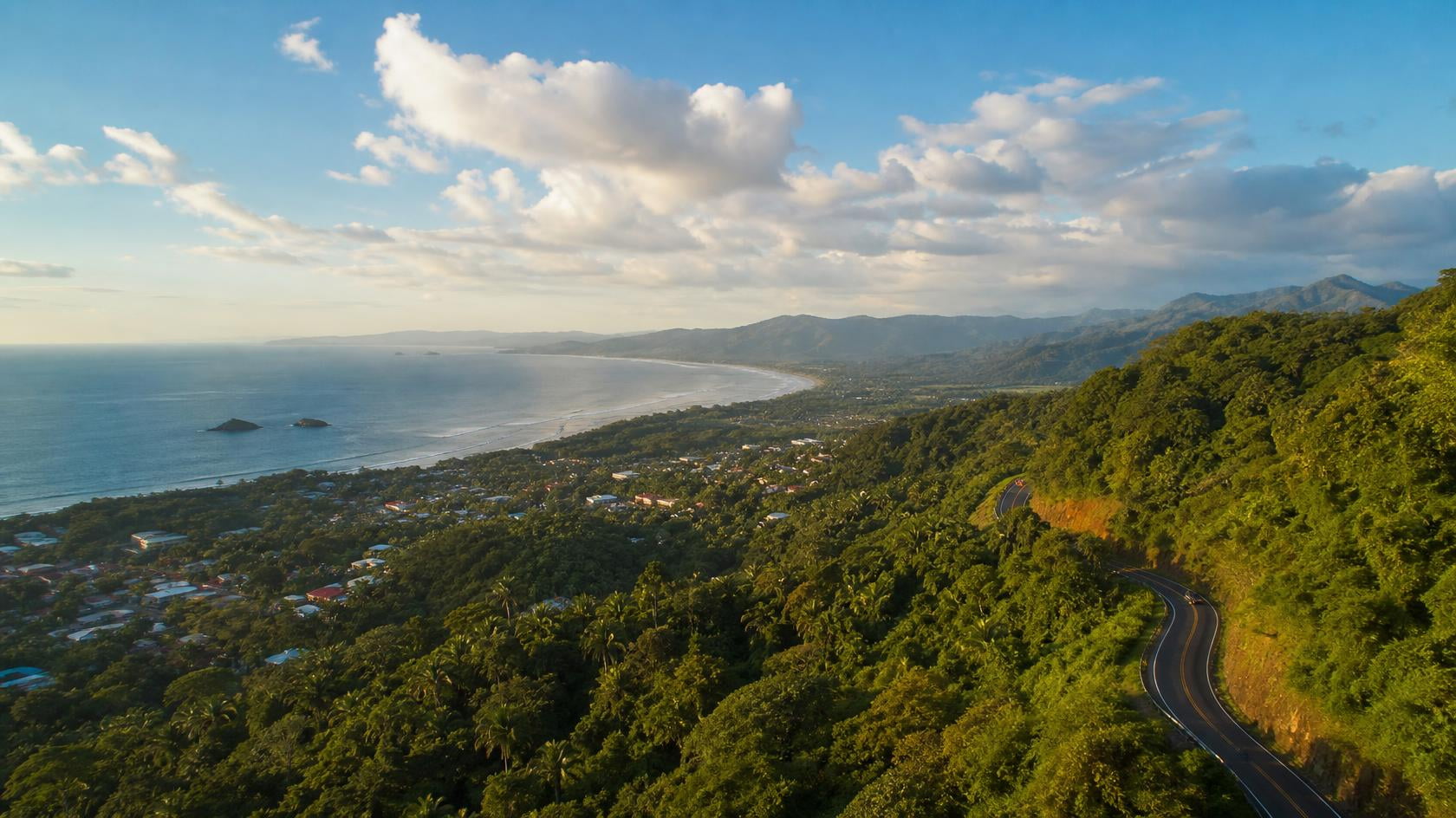
The Costanera Sur, which runs along the Pacific coast from Jacó south through Quepos, Dominical, and Uvita, is one of the better stretches of road in the country. It is paved, mostly in good condition, and offers one of the more scenic drives on the coast. The Interamericana, which connects San José to Guanacaste and the north, is a major highway that can be slow around the capital but clears significantly once past Alajuela.
The roads that lead off these main arteries are where conditions vary most. The road from the main highway into the Escaleras above Dominical requires a four-wheel-drive vehicle, particularly in green season. The roads around Santa Teresa and Mal País are unpaved but manageable in a high-clearance vehicle. The road across the Nicoya Peninsula from the Interamericana toward Nosara and Sámara is paved for most of its length but takes longer than the distance suggests.
A rental car gives the most flexibility and is the right choice for guests who want to explore at their own pace, move between multiple destinations, or stay in properties that are not easily served by transfers.
Four-wheel drive is not optional in Costa Rica; it is practical in most zones and essential in others. Green season road conditions in the South Pacific, the hillside roads above Nosara, and many of the tracks that lead to the most interesting properties all require ground clearance and traction that a standard vehicle cannot provide. Booking a four-wheel-drive SUV as the default, rather than upgrading reluctantly, is the right approach from the start.
International drivers licenses are accepted in Costa Rica. The minimum rental age is typically 21, with some agencies requiring 25 for certain vehicle categories. Insurance costs are worth understanding before arrival; the mandatory basic coverage required by law is separate from the collision damage waiver offered by rental companies, and the combination can add significantly to the daily rate.
Navigation works well with Google Maps or Waze. Both apps have current data for Costa Rica's road network and are reliable for the main routes. For more remote destinations, it is worth downloading offline maps before leaving the main highway, as mobile coverage is inconsistent in some zones.
Fuel stations are reliably present in towns and along main highways but become sparse in more remote areas. Filling up before leaving a town for a hillside property is a habit worth forming.
For guests who prefer not to navigate independently, a private driver is the most comfortable and often the most efficient option for transfers between zones.
A private driver knows the roads, the conditions, the shortcuts, and the local context. The transfer from San José to Nosara takes the same amount of time whether you are driving or being driven, but the experience is entirely different. No navigation decisions, no stress about road conditions, local knowledge available for the asking.
Shared shuttle services operate between most major destinations on the Pacific coast and offer a significantly more affordable option than private transfers. They run on fixed schedules between popular routes, Jacó to Manuel Antonio, San José to Nosara, Liberia to Tamarindo, and typically use comfortable minivans with air conditioning. The trade-off is flexibility; shuttle schedules are fixed and the route may include stops that add time.
Maison R&V coordinates private transfer arrangements for all villa bookings, with drivers who know the specific access routes to each property. For guests arriving at an airport after a long international flight, having a driver waiting with the property details and a vehicle already loaded is an arrival experience that sets the right tone for the week.
Costa Rica's domestic flight network is one of the most practical in Central America and is significantly underused by first-time visitors who default to driving.
The key routes for Pacific coast travelers are San José to Nosara, San José to Tamarindo, San José to Quepos for the Manuel Antonio and South Pacific zones, San José to Palmar Sur for the Osa Peninsula, and Liberia to San José for guests based in Guanacaste. Nature Air and Sansa are the main operators, with flights typically lasting between 25 and 50 minutes depending on the route.
The time savings are significant. The drive from San José to Nosara is approximately five hours in good conditions. The flight is forty-five minutes. For guests with a week in Costa Rica, that difference is meaningful. Two extra days of actual holiday rather than transit time is a straightforward calculation.
The aircraft are small; twin-engine propeller planes that carry between 12 and 19 passengers. The flights are low altitude and the views are extraordinary. For guests who have never flown over the Costa Rican landscape, the approach into a small coastal airstrip, with jungle below and ocean ahead, is one of the better arrivals in the country.
Luggage limits on domestic flights are strict: typically 12 to 15 kilograms per person in checked luggage, with limited overhead space. Guests with significant luggage should either ship bags ahead via private transfer or plan to check excess weight for a fee.
The Gulf of Nicoya separates the Nicoya Peninsula from the mainland, and crossing it by water taxi is one of the practical options for reaching Santa Teresa and Mal País without the long drive around the top of the gulf.
The ferry from Puntarenas to Paquera crosses in approximately 70 minutes and operates multiple times daily. From Paquera, the drive south to Santa Teresa takes another 90 minutes on unpaved roads. The total journey from San José is comparable in time to driving the long way around, but the ferry crossing offers a different kind of transition: arriving at Santa Teresa by sea rather than land shifts the register of the arrival in a way that guests tend to remember.
A faster option is the water taxi from Jacó to Montezuma or Mal País, which takes approximately 70 minutes and cuts the road journey significantly. This suits guests arriving from the Central Pacific zone rather than from San José.
Once based in a villa, the question of daily movement within a destination is separate from the transfer logistics.
In Nosara, a four-wheel-drive vehicle or ATV is practical for moving between the beach zones and the villa. The roads between Guiones and Pelada are manageable, but the hillside roads leading to properties above town require more clearance.
In Santa Teresa, the main road runs along the coast and is navigable in a high-clearance vehicle. The town is compact enough that many guests walk or use bicycles for daily movement.
In Tamarindo, the town center is walkable from most properties. A rental car is useful for day trips to neighboring beaches but not essential for guests staying close to the town.
In the South Pacific, a four-wheel-drive vehicle is effectively mandatory. The distances between Dominical, Uvita, and the hillside properties above both towns are short but the roads require the vehicle to manage them comfortably.
Maison R&V's concierge team advises on local transport options for each property as part of the pre-arrival coordination, including vehicle recommendations, local driver contacts, and any seasonal road considerations that affect access to the specific villa.
→ Read our guide to the Costa Rica 10-day itinerary
→ Read our guide to the best time to visit Costa Rica