
Santa Teresa has a reputation for being hard to reach. Getting to Santa Teresa and Mal País requires a choice between four distinct routes, each suited to a different kind of traveler. That reputation is partly deserved and partly outdated. The destination sits at the southern tip of the Nicoya Peninsula, which means it requires more intention than a beach town accessible by highway. But the journey has become considerably more manageable over the past decade, and for most travelers arriving from North America or Europe, the options are clearer than they first appear.
Understanding how to get there before you book is worth the fifteen minutes it takes. The right transfer choice affects how the first day feels, how much of the trip is spent in transit, and what condition the group arrives in.
There are four ways to reach Santa Teresa from San José or from an international arrival. Each suits a different kind of traveler, a different group size, and a different tolerance for the journey as part of the experience.
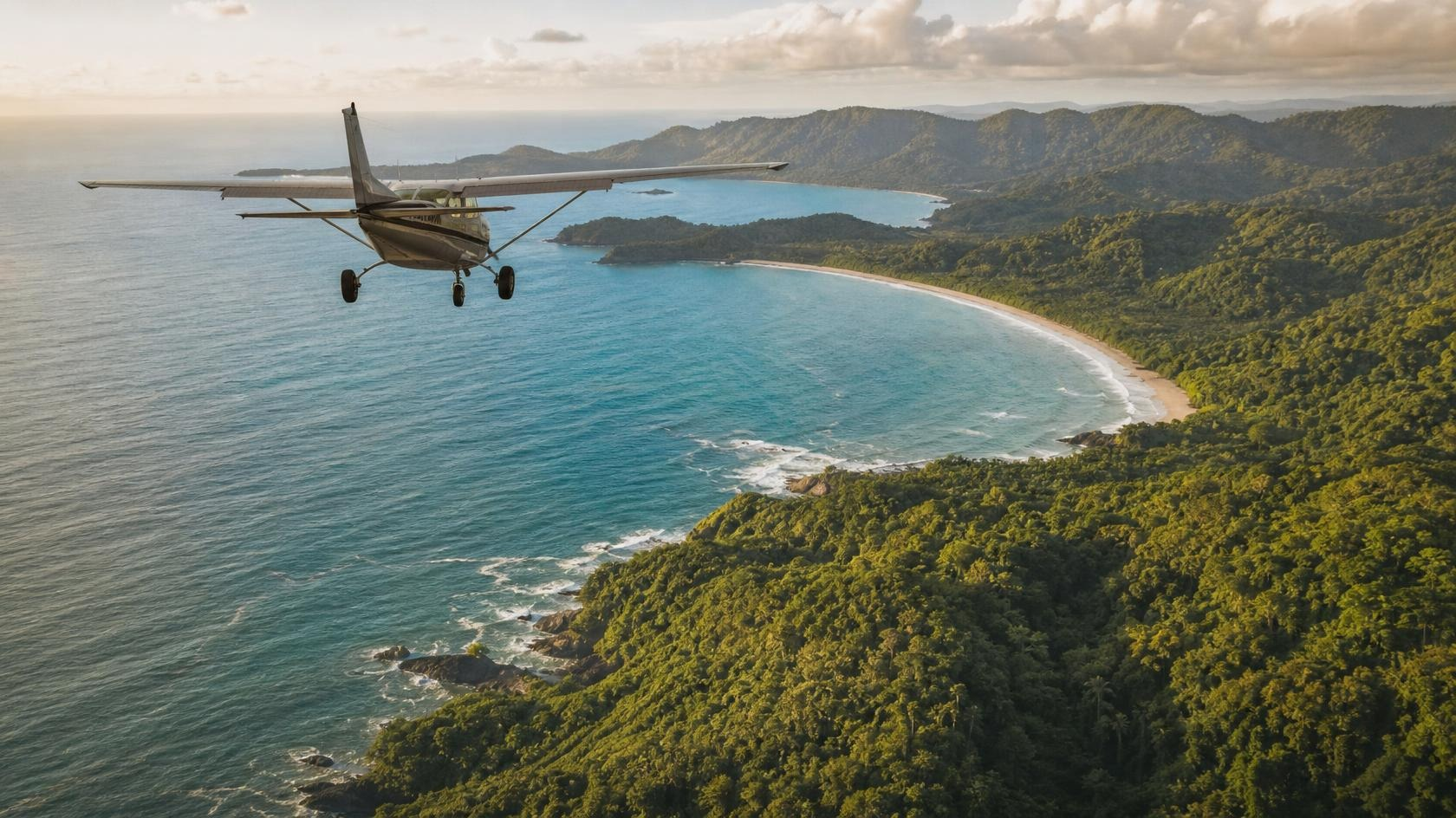
The fastest and most comfortable option for most travelers is a domestic flight from San José's Juan Santamaría International Airport or Tobías Bolaños International Airport in Pavas to the Cobano airstrip on the Nicoya Peninsula.
The flight takes approximately 25 minutes. From Cobano, Santa Teresa is a 20-minute drive on unpaved but manageable road. Total transfer time from landing in San José to arriving at a Santa Teresa villa is approximately one and a half to two hours, including the domestic connection.
Nature Air and Sansa are the main operators on this route. Flights run multiple times daily in peak season and less frequently in green season. The aircraft are small, typically 12 to 19 passengers, and luggage limits apply strictly: usually 12 to 15 kilograms per person in checked luggage. Guests traveling with surf equipment or significant bags should arrange separate ground transfer for excess luggage or ship items ahead.
The approach into Cobano, over the Gulf of Nicoya with the peninsula spread below, is one of the more memorable arrivals in Costa Rica. For groups of two to four guests, this is almost always the recommended option.
For guests traveling with surfboards, diving equipment, or significant luggage that exceeds domestic airline limits, a private charter flight is the most elegant solution. Small private aircraft can be arranged from San José or Liberia directly to Cobano with flexible luggage allowances and no shared schedule. Maison R&V coordinates private charter arrangements as part of the villa booking process.
The ferry crossing from Puntarenas to Paquera is the most scenic option and, for larger groups traveling with their own vehicle or significant luggage, often the most practical.
The crossing takes approximately 70 minutes and operates multiple times daily. From Paquera, the drive south to Santa Teresa takes approximately 90 minutes on unpaved roads through the Nicoya Peninsula. Total travel time from San José is approximately four hours including the drive to Puntarenas and the wait for the ferry.
The ferry itself is a genuine part of the journey. The crossing over the Gulf of Nicoya, with pelicans overhead and the peninsula visible ahead, produces a transition that a flight cannot. Many experienced Santa Teresa visitors prefer it specifically for this quality: arriving by sea rather than by air changes the register of the arrival.
For families with young children, rental cars, or groups where luggage makes a small plane impractical, the ferry is the natural choice. A four-wheel-drive vehicle is strongly recommended for the roads between Paquera and Santa Teresa, particularly in green season.
The water taxi from Jacó directly to Mal País or Santa Teresa is the fastest ground-and-sea option for guests arriving on the Central Pacific coast or connecting through Jacó after landing in San José.
The crossing takes approximately 70 minutes and runs once daily in most seasons, typically in the morning. It connects the Central Pacific coast directly to the tip of the Nicoya Peninsula without the longer overland drive or the need to cross the peninsula from the north.
For guests staying at a villa in Mal País specifically, the water taxi arrival is one of the more satisfying ways to reach the destination: stepping off a small boat onto the Pacific side of the peninsula, with the surf audible and the road into town minutes away.
Availability is limited and booking ahead is essential. The service does not run in rough sea conditions, which is worth understanding during the peak swell months of the green season.
The full drive from San José to Santa Teresa takes approximately four to four and a half hours in good conditions. The route goes north on the Interamericana, across the Friendship Bridge over the Tempisque River, and south down the Nicoya Peninsula through Carmona and Cóbano to Santa Teresa.
The road is paved for most of the route but becomes unpaved in the final section approaching Santa Teresa and Mal País. A four-wheel-drive vehicle is recommended. In green season, some sections require more attention, though the main route is generally passable year-round.
The overland drive suits guests who want the flexibility of their own vehicle during the stay, who are traveling with significant luggage or equipment, or who enjoy the drive itself as a way of arriving gradually. The Nicoya Peninsula interior, particularly around Cóbano, has a landscape that rewards the slower approach.
For guests using a private driver arranged through Maison R&V, the overland route removes the navigation question and adds local knowledge to the journey. A driver who knows the road, the conditions, and the specific access route to the villa makes the transfer a different experience from self-navigating in an unfamiliar rental car.
Guests arriving through Liberia's Daniel Oduber International Airport, which receives direct international flights from several North American hubs, now have the most efficient option available on the entire route.
Domestic flights operate directly from Liberia to Cobano, making this the fastest combination for international travelers. A direct flight from North America into Liberia, followed by a short domestic connection to Cobano and a 20-minute drive, puts most guests at their Santa Teresa villa in under three hours from landing. No San José connection, no long overland transfer, no unnecessary transit time.
For guests with flexibility on their international routing, flying into Liberia rather than San José specifically to use this connection is worth considering. The Liberia to Cobano domestic flight is the most streamlined arrival option currently available for reaching Santa Teresa from abroad.
For guests who want complete flexibility on timing, luggage, and routing, a private charter flight is the most refined way to reach Santa Teresa. Charters can be arranged from San José, Liberia, or any other domestic airstrip, with departure times set around the group's schedule rather than a fixed timetable.
The practical advantages are significant. No luggage restrictions mean surfboards, dive equipment, and generous bags travel without additional fees or ground transfers. Departure time adjusts to the group's arrival from an international flight rather than the other way around. And the aircraft, typically a four to six seat single or twin engine plane, carries only the people who came together.
For families, groups with equipment, or guests arriving late from an international connection, the private charter removes every point of friction in the transfer. Maison R&V arranges charter flights as part of the full concierge coordination for villa stays on the Nicoya Peninsula.
Road conditions on the Nicoya Peninsula vary by season. The dry season, December through April, produces firm, dry roads that are straightforward in any four-wheel-drive vehicle. Green season, May through November, brings mud and some rutted sections on the unpaved roads. The main route into Santa Teresa and Mal País is generally passable year-round, but properties on more remote tracks above the town may require guidance on conditions before arrival.
Luggage and surf equipment are worth planning around before choosing a transfer option. Surfboards typically cannot travel on domestic flights without advance arrangement and additional fees. The ferry and overland options accommodate boards in a vehicle without difficulty.
Group size affects the calculation. Two guests traveling light: domestic flight to Tambor. Four guests with surfboards and a week of luggage: ferry with a rental vehicle. Eight guests arriving together: private shuttle overland or a combination of domestic flight and vehicle transfer.
First-day experience matters more than most travelers account for. Arriving at a Santa Teresa villa at two in the afternoon after a domestic flight and a short transfer produces a different first evening than arriving at seven after a long overland journey. For guests with limited time, the domestic flight is almost always worth the additional cost.
Whether you are traveling from San José, Liberia, or connecting through another coastal destination, getting to Santa Teresa is straightforward once the right option is identified.
Maison R&V coordinates transfers for all villa bookings on the Nicoya Peninsula, with recommendations based on the specific group, the luggage situation, and the arrival airport. The goal is always the same: arriving at the villa ready to begin, not depleted by the journey.
→ Read our guide to getting around Costa Rica
→ Read our guide to Santa Teresa Costa Rica