
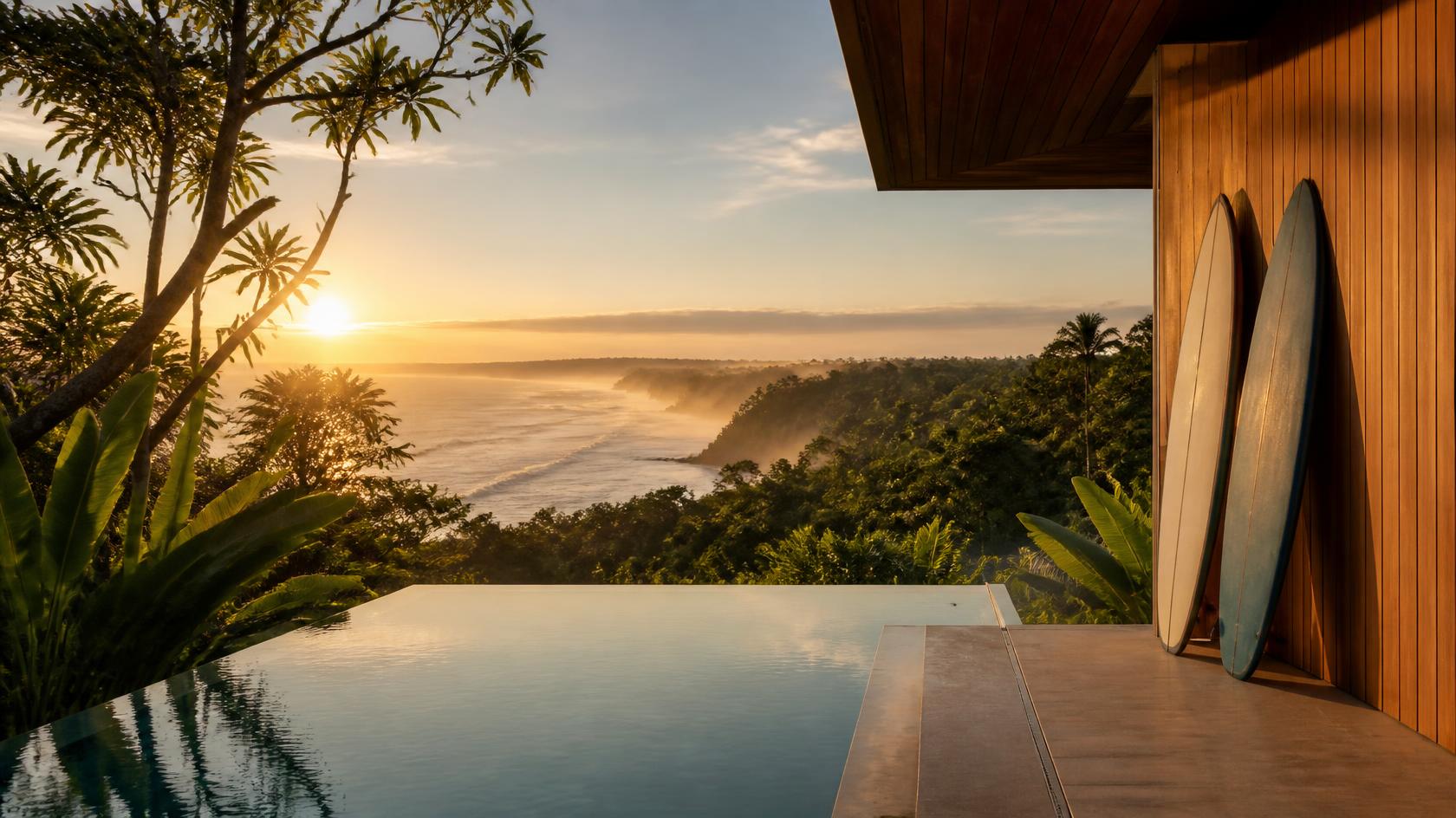
Costa Rica has been a serious surf destination for decades. The waves are real, the water is warm year-round, and the Pacific coast offers breaks suited to every level from first-timers to experienced surfers chasing powerful swells. What has changed is the quality of accommodation available to surfers who do not want to choose between being close to the water and being comfortable while they are out of it.
A private surf villa in Costa Rica solves that equation. The right property puts you minutes from a consistent break, with a pool to recover in, a kitchen stocked for early mornings, and enough space that the people you travel with can organise their own day without anyone negotiating a shared hotel corridor.
The wave quality here is not incidental. It is the reason for the trip. Choosing a villa that understands that, and positions itself accordingly, is where planning a surf holiday in Costa Rica actually begins.
The Pacific coast of Costa Rica benefits from two distinct swell windows that together create year-round surfable conditions.
The dry season, December through April, brings offshore winds and clean conditions on the Nicoya Peninsula. Santa Teresa, Mal País, and Nosara receive consistent swells with good shape, and the reliable weather makes early morning sessions particularly rewarding. The water is clear, the crowds manageable outside of peak holiday weeks, and the conditions predictable enough to plan a trip around.
The green season, May through November, shifts the dynamic. Swells become more powerful and more frequent, particularly from the south and southwest. Dominical and the South Pacific come into their own during these months, receiving some of the heaviest and most consistent waves on the coast. For experienced surfers, this is often the preferred window.
Tamarindo and the beaches of northern Guanacaste offer a gentler introduction to Costa Rica surf. The waves here are forgiving enough for beginners and intermediates, with a well-developed infrastructure of surf schools and rental shops. The dry season reliability makes it particularly accessible for first-time visitors.
Santa Teresa has built a global reputation as a surf destination, and that reputation is deserved. The beach runs for several kilometers, exposed enough to receive consistent Pacific swells and varied enough to offer different options depending on conditions and experience level.
The town around the break has matured without losing its character. The restaurants are good, the surf culture is genuine, and the general energy of the place, creative, wellness-focused, international, suits travelers who want more from a surf trip than just the waves.
Casa Taman sits in the quieter northern end of Santa Teresa, on a private estate with direct beach access. The break in front of the property is less crowded than the main town beach and delivers consistent conditions during the dry season. For a small group of surfers who want to walk from breakfast to the water in under two minutes, the position is close to ideal.
Casa Lanui, on the same private estate, accommodates larger surf groups with seven bedrooms, panoramic ocean views, and the same proximity to the water. The combination of the two properties suits a group that wants scale without losing the intimacy of a private surf camp.
Villa Kuji Biri, perched just outside Santa Teresa in Mal País, sits ten minutes from both the Santa Teresa break and the more exposed waves at Mal País itself. The seclusion is greater here, the architecture more considered, and the experience more removed from the social scene of the town. For surfers who want world-class waves close by and genuine privacy when they are not in the water, this combination is difficult to find elsewhere on the Nicoya Peninsula.
Esterillos does not have Santa Teresa's profile, and that is entirely the point.
The beach here is long, dark-sand, and almost always empty. The break is consistent, the crowds non-existent, and the surrounding landscape — jungle pressing close to the water, no development to speak of — has a rawness that more popular destinations have long since traded away.
Villa Assinie sits directly on this beach. Four bedrooms, open living spaces, and the Pacific audible from every room. For a couple or a small group of surfers who want a quiet week with reliable waves and no competition in the lineup, Esterillos delivers something increasingly rare on the Costa Rican coast.
Stealing Time Private Resort, perched above the same stretch of coastline in Esterillos Oeste, adds another dimension. The yoga shala, cold plunge, and gym make it a natural fit for surfers who take recovery as seriously as the sessions themselves. The beach is five minutes on foot. The property is otherwise entirely self-contained, with the kind of exclusive-use infrastructure that turns a surf trip into something closer to a retreat.
Tamarindo suits a different kind of surf trip. The town is lively, the infrastructure is well-developed, and the waves at Playa Tamarindo and nearby Playa Langosta offer forgiving beach breaks suited to surfers building confidence or returning to the water after time away.
Casa Monoi sits steps from both beaches within a gated community, a well-positioned property for a group that wants easy surf access alongside the restaurants and social energy of Tamarindo. Sunset House, on the same grounds as Casa Alang Alang, adds scale for larger groups while maintaining the same proximity to the water.
The trade-off here is the crowd. Tamarindo is one of the most popular surf towns in Costa Rica, and the main break reflects that during peak season. For groups where some members surf and others prefer to explore a town with good food and nightlife, the balance works well.
Dominical is not a destination for beginners. The beach break here receives powerful south swells, and the wave has a reputation that draws experienced surfers from around the world specifically to surf it. The town is small and low-key in the way that Santa Teresa was fifteen years ago.
Villa Bella Vina, in the hills above Dominical, offers five bedrooms, panoramic ocean views, and easy access to both Dominical beach and the neighboring breaks of Playa Hermosa and Uvita. For a group of capable surfers who want a sophisticated base close to some of the most consistent waves on the South Pacific coast, the position works well across both dry season and green season conditions.
Casa Solaz, also near Dominical, offers a more intimate option — four bedrooms, contemporary design, and the same access to the South Pacific's surf without the scale of a larger property. For a small group of serious surfers, the combination of quality waves, quality accommodation, and the absence of crowds makes the South Pacific one of the most compelling surf destinations in the country.
The rhythm of a surf villa stay organises itself naturally when the property is well-chosen.
Sessions happen at dawn and again in the late afternoon, when the winds are most favorable and the light is best. The middle of the day belongs to the pool, recovery, and food. A well-stocked kitchen and a private chef who understands early mornings, coffee ready before sunrise, breakfast available after the first session, makes the operational side of a surf trip disappear.
A concierge team that knows the coast can add what the villa alone cannot. A surf guide for less familiar breaks. A board rental or shaping appointment arranged in advance. A massage therapist at the villa for the afternoon of day three, when the body starts to feel the accumulated sessions. Transport to a different break when conditions shift.
→ Read our guide to luxury concierge service in Costa Rica
Maison R&V coordinates these details as part of the stay, with knowledge of the specific conditions at each location, the best local surf instructors, and the equipment suppliers worth trusting. The goal is a week where the surfing is the focus and everything around it simply works.
→ Read our guide to the best time to visit Costa Rica
A few practical questions are worth answering before booking.
How far is the villa from the water, and how does that distance work in practice? A five-minute drive is different from a two-minute walk when you are checking conditions at dawn. What is the break in front of or closest to the property, and does it suit the level of the group? What does the villa offer for non-surfing hours, pool, shade, recovery space, food? And how is the kitchen configured for early starts?
The best surf villa in Costa Rica is not necessarily the closest to a famous break. It is the one that fits the way the group actually surfs, their level, their schedule, and the balance they want between time in the water and time out of it.